Google Will Turn Off Search for Schools That Reject AI. Should Big Tech Have That Much Power?
Schools that block Google's AI tools may lose Google Search for students. Here's why that matters, and five questions parents should ask their child's school.
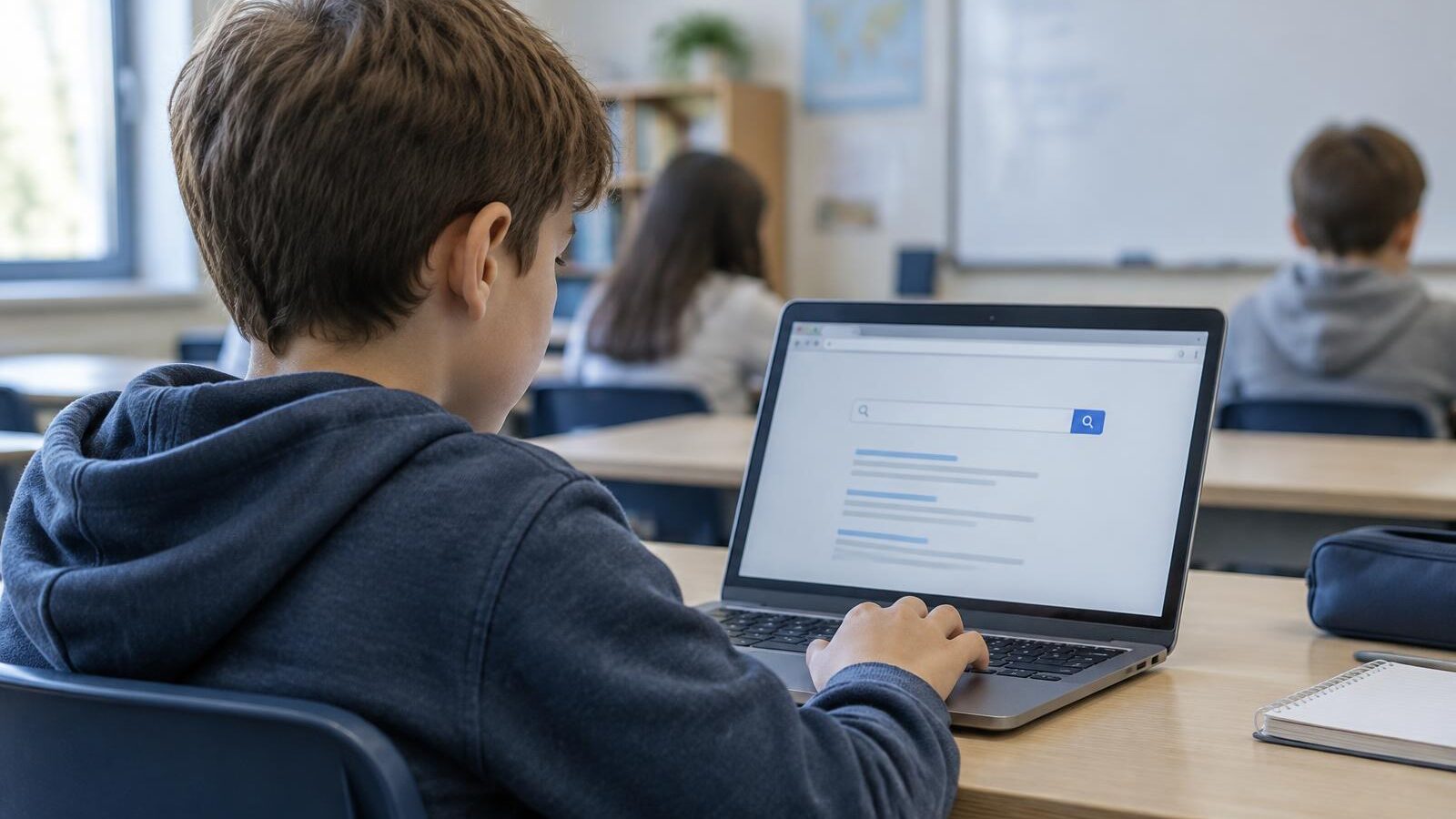
For years, Google has been one of the most familiar names in classrooms.
Children use Google Search to research homework. Teachers use Google Classroom to manage lessons. Schools rely on Google Workspace for everyday learning.
But a new report from The New York Times has raised an uncomfortable question about the future of AI in education.
What happens when a school wants Google Search, but doesn't want Google's AI?
According to the report, schools that choose to block Google's AI tools entirely could also lose access to Google Search for their students.
That's a remarkable position for schools to find themselves in.
And it deserves a much bigger conversation.
What Is Google Changing?
Google is expanding its AI capabilities across its education products, including tools designed to help students learn, research and solve problems.
The company is also introducing more controls for schools over how students access AI.
On the surface, that sounds like progress.
Schools need age-appropriate technology. They need control over what students can access. And they need the flexibility to introduce AI when they believe their pupils are ready.
But there's a catch.
According to reporting published on 3 November 2026, schools that completely disable Google's AI capabilities may also lose Google Search access for affected student accounts.
Google's position reflects how closely AI has become integrated into its search experience.
But from a school's perspective, the distinction matters enormously.
A school might support traditional online research while deciding that its younger pupils are not yet ready for generative AI.
Why should those two decisions have to be connected?
Google Search and Generative AI Are Not the Same Thing
Searching for information and asking AI to generate an answer are two different learning experiences.
Traditional search encourages students to find sources, compare information, read different perspectives and form conclusions.
Generative AI can produce an immediate response, often without requiring the same research process.
Both can be useful.
Both have limitations.
And both require digital literacy.
But they are not interchangeable.
A teacher might want a 10-year-old to research the solar system using websites, books and trusted educational resources.
That doesn't automatically mean the same child should be using AI to generate an explanation or complete an assignment.
Schools should be able to make that distinction.
The Bigger Issue Is Choice
This debate isn't really about whether AI belongs in education.
AI is already changing how children learn, and pretending otherwise won't prepare them for the future.
The real question is whether schools and parents should have meaningful control over when and how children are introduced to it.
A school might decide to introduce AI in Year 9 but not Year 5.
Another might want supervised AI lessons while restricting independent use.
A third might prefer to wait until its teachers have received proper training.
These are reasonable educational decisions.
They should be based on children's developmental needs, teacher expertise and evidence about learning outcomes.
Not simply on how a technology company chooses to package its products.
When One Company Becomes Part of the Classroom Infrastructure
There's another reason this story matters.
Google isn't just another educational app.
Its products are deeply embedded in how many schools operate.
When a technology becomes part of everyday classroom infrastructure, decisions made by its provider can affect millions of children.
That creates a responsibility that goes beyond product innovation.
It raises questions about competition, school independence and the balance of power between technology companies and education systems.
Schools should not feel that their only options are to accept a company's preferred technology direction or lose access to tools they already depend on.
And this is not a concern limited to Google.
As AI becomes integrated into search engines, productivity software, educational platforms and children's devices, similar questions will arise across the technology industry.
But Children Do Need to Learn About AI
There is another side to this debate.
Keeping children away from AI indefinitely is not a realistic educational strategy.
AI is becoming part of the world they are growing up in.
Children will encounter it through search engines, smartphones, homework platforms, social media and eventually their workplaces.
They need to understand what AI can do, where it makes mistakes, how it uses information and why its answers should not always be trusted.
They also need to learn when not to use it.
The answer isn't to reject AI completely.
It's to introduce it thoughtfully.
A younger child might begin by learning how to recognise AI-generated content.
An older student might use an AI tool to explore a difficult concept, then verify its explanation using independent sources.
A teenager might learn how to use AI productively without allowing it to replace their own thinking.
That is AI literacy.
And it should be built around education, not commercial pressure.
What Should Parents Ask Their Child's School?
Most parents have very little visibility into how AI is being introduced into everyday classroom activities.
This news is a good reason to start asking questions.
Here are five worth discussing with your child's school:
- Does my child have access to generative AI through their school account? Find out which features are available and whether they are enabled by default.
- Can the school restrict AI without removing ordinary research tools? Ask what controls administrators actually have.
- At what age are pupils introduced to AI? Is there a clear policy that reflects children's ages and maturity?
- Are teachers receiving training? Children need guidance from adults who understand both the benefits and limitations.
- How are students being taught to question AI-generated answers? Critical thinking should remain central to learning.
Parents don't need to become AI experts overnight.
But they deserve to understand what technology their children are using and why.
Our Approach at Young Minds App: Prepare, Not Just Protect
At Young Minds App, we believe children need more than restrictions.
They need guidance, education and opportunities to develop healthy digital habits.
That's why our approach has always been about preparing children for technology, not simply keeping them away from it.
We believe in gradual introduction, age-appropriate boundaries and helping children understand the digital world before expecting them to navigate it independently.
The same principles should apply to AI.
Children need opportunities to explore technology safely.
But adults must retain the ability to decide when, how and under what conditions that exploration happens.
Technology should support those decisions, not take them away.
The Question Google Needs to Answer
Google has played an enormous role in making information accessible.
And AI has the potential to make learning more personalised, engaging and inclusive.
Those are opportunities worth exploring.
But schools should be free to embrace some technologies while questioning others.
They should be able to say yes to online research and not yet to generative AI.
They should be able to introduce AI gradually, based on what works for their students.
Because the future of education should be shaped by children's needs, not by the commercial priorities of technology companies.
And perhaps that's the biggest lesson from this story.
The question isn't simply whether children should use AI.
It's who gets to decide.
Young Minds App helps families introduce technology gradually, with healthy boundaries, safer digital environments and practical digital education. Learn more at youngmindsapp.co.uk.
Sources
- The New York Times, 3 November 2026, “Google Will Turn Off Search for Schools That Reject A.I.”
- Google's official education product announcements and administrator guidance, November 2026.